


How Foresight Is Reshaping Strategy for Associations and Certification Boards
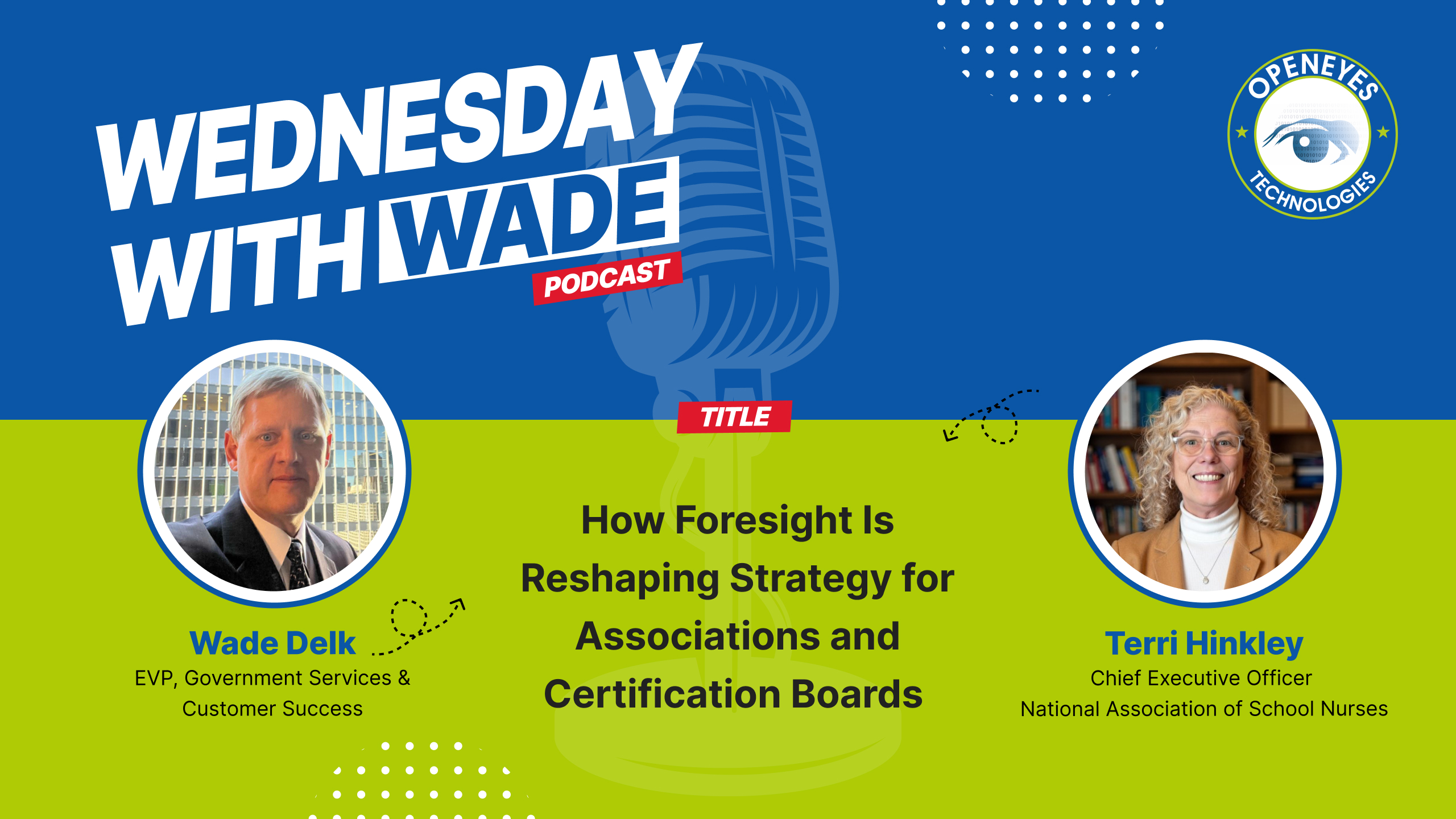
In this episode of Wednesday With Wade, Wade Delk, EVP of Government Services and Customer Success at OpenEyes Technologies, welcomes Terri Hinkley, CEO of the National Association of School Nurses (NASN), for a wide-ranging conversation on strategy, foresight, and competency, using curling, unexpectedly, as the throughline.
Drawing on her experience leading NASN through a national nursing workforce shortage and a shift toward competency-based credentialing, Terri explains why foresight and strategy are two different disciplines, how curling’s shot-by-shot recalibration mirrors what strategic leadership actually requires, and what changed at NASN once the organization started looking further ahead.
- How Foresight Is Reshaping Strategy for Associations and Certification Boards 27:48
Why Curling Is a Better Strategy Metaphor Than Chess
Terri curled for years before moving to the U.S., and she uses the sport to explain something most strategic plans get wrong: teams commit to a plan for each “end” of play, but they’re re-reading the ice and adjusting after nearly every throw.
Shots don’t always land where they’re called. The ice itself changes condition over the course of a match. Even the stones behave differently from one to the next, which is why elite teams assign specific rocks to specific players based on how each one is performing that day.
Her framing: You are not playing for where the stone is. You are playing for where it will be. A strategy that can’t be revised mid-game isn’t really a strategy, it’s a guess with a deadline.
Strategy Is a Microscope, Foresight Is a Telescope
Terri draws a hard line between two terms leaders tend to use interchangeably.
Strategy operates on a 1-to-3-year horizon, shorter than the 5-year window that was common before the pandemic. It asks: given what we know now, what do we do next?
Foresight operates on a much longer horizon, typically 5 to 20 years out. It asks a different question: what social, economic, political, and technological forces are reshaping our field, and what does that mean for us before it becomes urgent?
Neither replaces the other. You can’t run daily operations off a 20-year forecast, and you can’t see around corners with a 3-year plan. The two disciplines work best combined: foresight identifies which long-term shifts matter, and strategy turns that into near-term action.
The Real-World Test: NASN’s Shift to Competency-Based Credentialing
The clearest example from the conversation is NASN’s own pivot.
The U.S. is facing a projected shortage of up to a million nurses in the coming years, driven by attrition, retirement, and a shortage of faculty to train new nurses. School nursing compounds the problem: it’s frequently a solo-practitioner role. A school nurse often works without a physician or care team down the hall to double-check a judgment call, unlike a hospital setting where that support is built in.
NASN’s historical approach leaned on educational minimums as the proxy for readiness. Foresight work, combined with what the organization was already seeing on the ground, pushed NASN toward a different standard: defining the specific competencies a school nurse needs for an autonomous, hybrid acute-care, and public-health role, rather than assuming a degree alone guarantees it.
Foresight didn’t replace NASN’s strategic plan. It informed which three-year bets were worth making.
What This Means for Certification and Association Leaders
Terri points to a broader pattern reshaping the credentialing world: new entrants are moving into territory certification boards used to hold alone. Employers are issuing their own credentials. Universities under enrollment pressure are expanding into certification. That shift doesn’t show up as a strategic-planning problem, it shows up years later as a strategic crisis, after the disruption has already happened. Organizations that treat foresight as optional are, by definition, reactive. They’re optimizing for a version of the field that already exists.
Final Thought: Foresight Is the Leadership Skill of the Next Decade
Terri’s closing point: she believes foresight is the single most important leadership competency for twenty-first-century leaders, particularly in the association and certification space, where disruption is coming from multiple directions at once.
For leaders who want to build the skill without becoming professional futurists, she points to two resources for exactly that translation work: the Institute for Credentialing Excellence’s Future of Credentialing report, and ASAE’s ForesightWorks, both of which turn macro trend data into practical implications for association and certification leaders.
Listen to the Full Episode
Join Wade and Terri for a conversation on strategy, foresight, and what it takes to lead a certification organization through a shifting workforce and a shifting field. Whether you’re an association executive, a certification program leader, a workforce development professional, or simply curious how a curling strategy translates to the boardroom, this episode offers a practical way to think about the difference between planning for next year and preparing for the next decade.