


Why Brand Foundations Still Matter More Than AI in Advertising
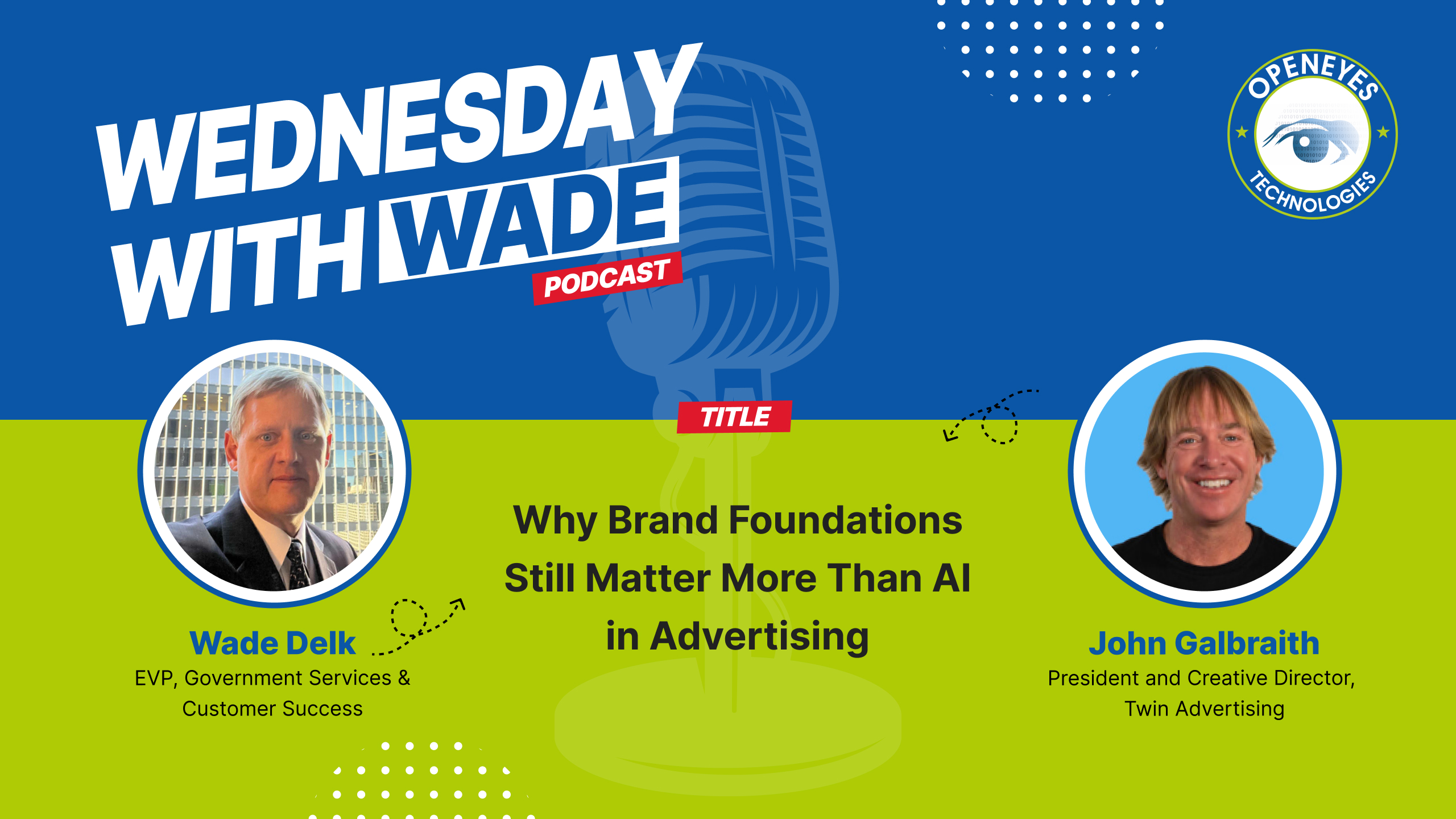
In this episode of Wednesday With Wade, Wade Delk, EVP of Government Services and Customer Success at OpenEyes Technologies, welcomes John Galbraith, President and Creative Director at Twin Advertising, for a candid conversation on how advertising has evolved over the past decade and what continues to separate effective campaigns from forgettable ones.
As paid social media and artificial intelligence reshape how agencies build and deliver campaigns, John offers a grounded perspective: technology has changed the tools, but it has not changed the fundamentals. Strong brands are still built the same way they always have been, through patience, clarity, and a deep understanding of the audience.
This conversation explores the shift from traditional to digital advertising, the role AI now plays inside agencies, and why brand foundations remain the most reliable predictor of long-term success.
- Why Brand Foundations Still Matter More Than AI in Advertising 19:00
Why Traditional Advertising Has Given Way to Precision Targeting
According to John, traditional advertising, including television, radio, and print, effectively ended eight to ten years ago. In its place, paid social media has become the primary channel for most campaigns.
John challenges a common misconception that social advertising only reaches younger audiences. In reality, social platforms reach nearly everyone, regardless of age or generation. What has changed is not who can be reached, but how precisely they can be targeted. Modern platforms allow agencies to define audiences by age, demographic, significantly reducing wasted spend. Unlike legacy media, performance data is now available almost immediately, allowing for faster optimization and clearer accountability.
Brand Building Remains the Foundation of Every Successful Campaign
Despite decades of change in advertising technology, John maintains that one principle has remained constant: a brand must be built before it can be sold. He compares this to constructing a house, the foundation must be in place before anything else can be added.
This belief shapes how John’s agency works with clients. He explains that his team will not take on a client who wants to launch advertising before establishing a clear brand identity or completing a functional website. He also points to a long-standing industry principle, audiences typically need to see an advertisement several times before they take action. Sustainable results, he notes, depend on patience and proper sequencing, not just speed.
AI as a Tool, Not a Substitute for Strategy
A significant portion of the conversation focuses on artificial intelligence and its growing role within advertising agencies. John explains that his team uses AI daily for tasks such as building creative assets, buy media, and generating headline options. However, he is careful to note that AI is only as effective as the direction it is given.
He shares that AI-generated client communications are often easy to identify, as they tend to lack the specificity and personal context that make messaging resonate. He encourages clients to communicate their own intentions clearly, rather than relying solely on AI-generated input.
John also recounts a recent new business pitch in which his team identified that a competing agency’s website had been built almost entirely using AI, resulting in messaging that felt impersonal and generic. Highlighting this distinction during the pitch played a meaningful role in winning the account.
Evolving Roles Within the Agency
John speaks openly about how certain roles within advertising agencies are changing. His agency has not employed a traditional graphic designer in over two years, not because design skills no longer matters, but because the nature of the work has shifted. What he now looks for is someone capable of directing AI effectively and exercising the creative judgment needed to evaluate the final output.
This reflects a broader theme throughout the conversation: AI is increasingly responsible for execution, while human judgment remains essential for direction and quality control.
Lessons From Three Decades in Advertising
Throughout the episode, John shares additional insights drawn from his career. He identifies one of the most common mistakes businesses make as underinvesting in marketing after allocating significant resources to physical infrastructure, leaving little budget to build awareness once the business is ready to launch.
He also reflects on a defining moment in his career, pairing a small computer company with the launch of high-speed internet, a campaign that helped grow the client’s revenue from 1.5 million to 7.5 million dollars in sixteen months.
When asked about the best advice he has received, John points to the value of listening over speaking, noting that the most capable people in any room are often the quietest. He attributes much of his agency’s culture to this principle, along with a consistent practice of taking personal responsibility for both mistakes and successes.
Advertising Is Becoming More Strategic, Not Less Human
One of the strongest takeaways from this conversation is that AI is not reducing the importance of strategic and creative judgment in advertising, it is increasing it. As AI continues to handle more execution-based work, the qualities that distinguish successful agencies become more valuable:
- Brand strategy and sequencing
- Creative direction and judgment
- Clear, personalized client communication
- The discipline to build a strong foundation before scaling visibility
Technology will continue to change how campaigns are built and measured, but trust, brand strength, and long-term results continue to depend on people.
Final Thought: AI Can Execute, But It Cannot Build a Brand
Effective advertising has never been solely about speed or volume. It depends on understanding an audience, building a brand that earns trust, and recognizing when patience matters more than immediacy.
As more agencies integrate AI into their workflows, those that stand out will not necessarily be the fastest. They will be the ones who continue to apply sound strategic fundamentals while using AI to support, rather than replace, human judgment.
Listen to the Full Episode
Join Wade and John for a deeper conversation on AI in advertising, paid social strategy, and the lessons three decades in the industry have taught him about building brands that last.
If you are a business leader, marketer, or agency owner navigating AI’s role in advertising, this episode offers practical insight into building campaigns rooted in strong fundamentals.