


The Future of Work: Why Skills-Based Learning Is Replacing Job Titles
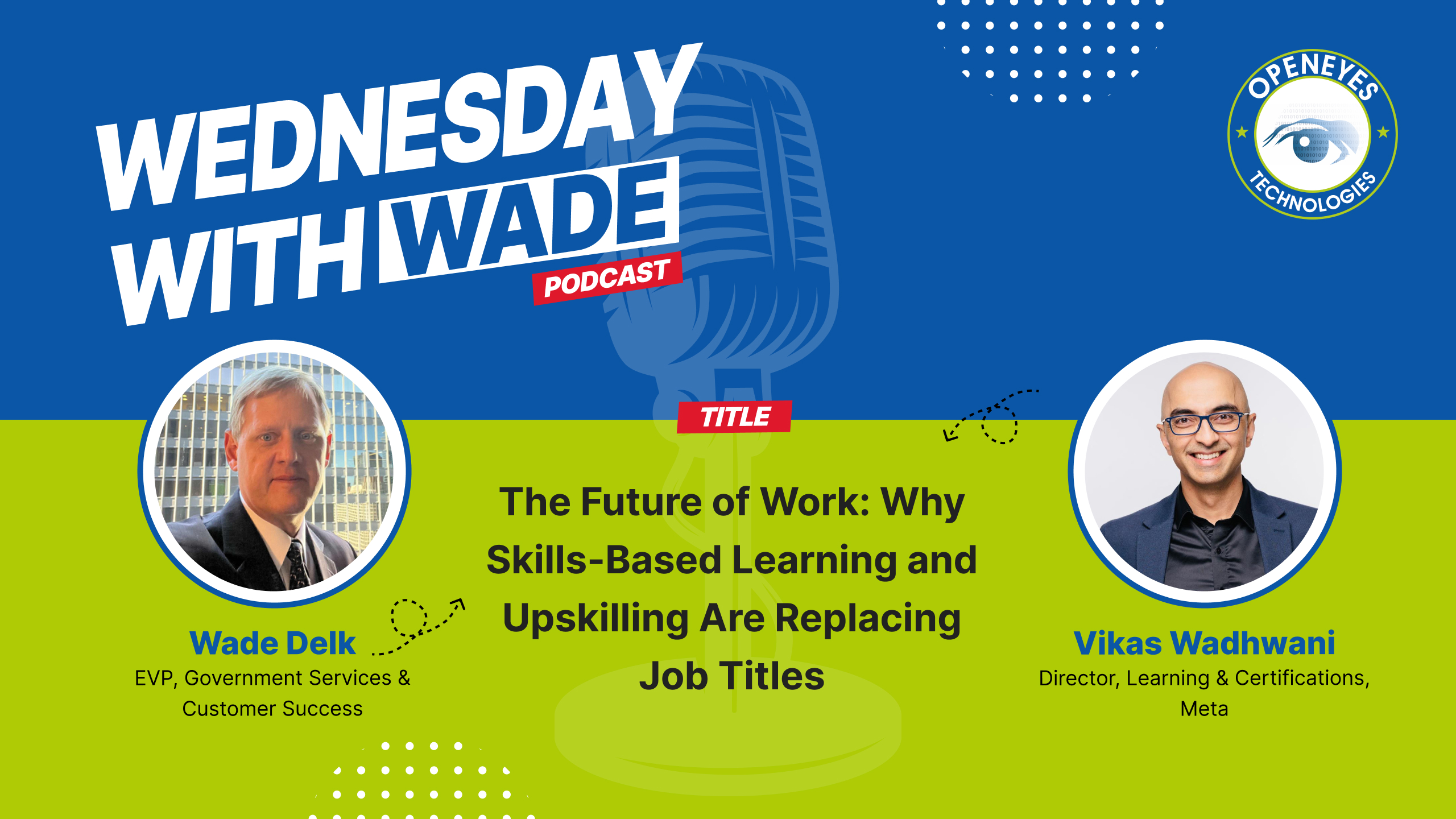
In this episode of Wednesday With Wade, Wade Delk, EVP of Government Services and Customer Success at OpenEyes Technologies, welcomes Vikas Wadhwani, Director of Learning and Certifications at Meta.
As artificial intelligence accelerates and automation reshapes entire industries, Vikas shares a powerful insight: job titles are becoming less reliable indicators of value. Skills are becoming the true currency of the modern workforce.
This conversation explores how organizations must rethink workforce development, redesign credentialing systems, and close the growing skills gap in an AI-driven economy.
- The Future of Work: Why Skills-Based Learning Is Replacing Job Titles 19:43
Why Skills, Not Roles, Are Defining the Future of Work
For decades, careers were built around stability. Degrees led to job titles. Job titles led to promotions. Career ladders were predictable; that model is rapidly evolving.
AI-driven disruption, global talent competition, and the rise of freelance and project-based work have made job roles harder to forecast. As Vikas puts it:
“Predicting future job roles has never been harder. Preparing for them has never been more vital.”
Instead of organizing talent around static job descriptions, forward-thinking organizations are shifting toward skills-based strategies, prioritizing observable, demonstrable capabilities over titles alone.
Skills are no longer a line item; they are the strategy.
The Shrinking Lifespan of Skills in the AI Era
One of the most compelling moments in the episode centers around the compressed lifecycle of skills. Vikas explains that even if a credential remains relevant for only a year, it may still be worth building.
“If you can build something which a person can reasonably say that they are good with the skill for a period of one year, that is worth pursuing and building and marketing.”
That statement challenges traditional thinking.
In a world moving at AI speed, timing matters more than longevity. Organizations must move faster: developing curriculum, validating competencies, and refreshing credentials more frequently than ever before.
The winners will not be those who build permanent structures; they will be those who build adaptable ones.
Rethinking Learning and Certification for Workforce Transformation
Traditional instructional design models still provide structure. But the mindset behind them must evolve.
Instead of analyzing what jobs required yesterday, organizations must anticipate which skills will be marketable tomorrow.
Generative AI has made this shift more achievable. It enables faster content creation, personalized learning pathways, and scalable delivery models. But Vikas emphasizes that human oversight remains critical. AI can accelerate development; it cannot replace judgment, credibility, or integrity.
Assessment must evolve as well. The future of credentialing lies not in testing what someone knows, but in validating what they can do. Performance-based evaluation, scenario simulations, and real-world demonstrations of capability will define the next generation of certification.
The goal is no longer information recall; it is proven competence.
The End of Linear Career Ladders
Another key insight from the conversation: the traditional certification ladder may be losing relevance.
Instead of rigid pathways from foundational to expert, the future portfolio is modular. Learners will build personalized combinations of skills, mixing and matching credentials based on career goals, industry demand, and personal interest.
Careers will look less like ladders and more like toolkits. This flexibility supports mobility, specialization, and differentiation in a competitive marketplace.
The Question Every Credential Must Answer
Perhaps the most powerful design principle shared in this episode is deceptively simple:
Why would a candidate care to have this credential on their resume?
If a credential does not improve earning potential, increase mobility, unlock interviews, or differentiate someone in the marketplace, its value is questionable.
Training should not feel like a requirement; it should feel like an asset.
That shift in thinking changes everything about how programs are built.
Upskilling Is No Longer Optional
Continuous learning is no longer separate from the job itself.
“The biggest boost to productivity comes from the non-productive hours.”
The time spent acquiring new skills is what drives better performance, faster innovation, and long-term relevance. Upskilling and reskilling are no longer add-ons. They are embedded in professional survival.
Organizations that recognize this will close the skills gap faster, retain stronger talent, and remain competitive in an AI-driven world.
Those that don’t risk falling behind.
Final Thought: Capability Is the New Career Currency
The future of work will not be defined by degrees or job titles alone.
It will be defined by demonstratable skills, adaptability, and continuous learning.
As leaders like Vikas help reshape workforce development and credential strategy, one thing becomes clear: the shift to skills-based thinking is not a passing trend.
It is a structural transformation.
Listen to the Full Episode
Join Wade and Vikas for a deeper conversation on skills-based learning, AI-driven workforce transformation, credential innovation, and the future of professional development.
If you are a learning leader, HR executive, workforce strategist, or certification professional, this episode is essential listening.