


Reimagining Healthcare Through Behavior Change: Building a New Profession from the Ground Up
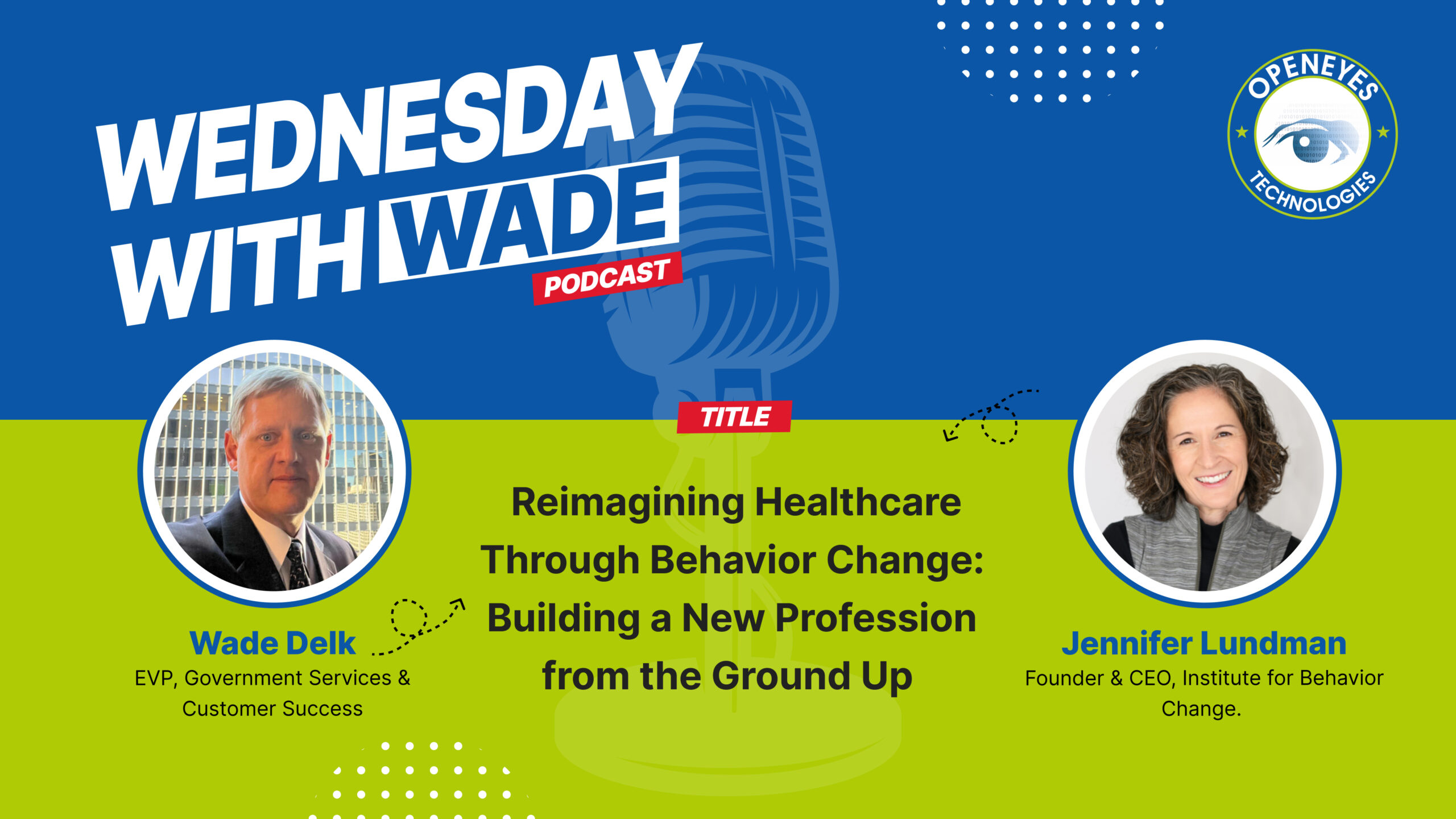
In this episode of Wednesday With Wade, Wade Delk, EVP, Government Services and Customer Success at OpenEyes Technologies, welcomes Jennifer Lundman, Founder and CEO of the Institute for Behavior Change.
Jennifer shares the bold journey of building an entirely new organization and certification framework designed to embed behavior change professionals directly into healthcare systems. With a focus on patient outcomes, system-level innovation, and professional integrity, this conversation explores what it truly takes to create a new role inside an industry that isn’t always ready to change.
- Reimagining Healthcare Through Behavior Change: Building a New Profession from the Ground Up 22:19
Key Takeaways
1. Innovation Doesn’t Start with Answers, It Starts with Questions
Jennifer didn’t launch the Institute with a fixed blueprint. Instead, it emerged from years of observing gaps in healthcare systems and asking one critical question:
How do we truly support long-term behavior change inside clinical care?
The result is an organization built through iteration, collaboration, and constant learning, not assumptions.
2. Healthcare Needs Behavior Change Specialists, Not Side Roles
Behavior change is often treated as an add-on responsibility across healthcare disciplines. Jennifer challenges this approach by creating a role that exists solely to support patients through sustainable behavior change.
“This role doesn’t carry the agenda of another field. Their only job is to partner with the patient.”
This clarity is what makes the role transformative.
3. You Can’t Insert Change Without Understanding the System
One of the biggest challenges Jennifer highlights is integrating new roles into healthcare systems that have operated the same way for decades.
Rather than imposing solutions, the Institute works with clinical teams to:
- Define job responsibilities
- Align workflows
- Build trust across disciplines
Change works best when it’s co-created.
4. Certification Is About Integrity, Not Just Credentials
The Institute for Behavior Change is building more than a certification, it’s establishing shared language, standards, ethics, and professional identity for behavior change practitioners.
Jennifer emphasizes that certification should:
- Strengthen trust in healthcare teams
- Reduce dilution of behavior change expertise
- Support patient-centered outcomes
Without standards, progress stalls.
5. Credentialing Systems Themselves Can Resist Innovation
One unexpected obstacle? Traditional credentialing frameworks.
“We live in innovation every day but credentialing systems aren’t always built for that.”
Navigating legacy structures while pushing for evolution has been one of the most complex challenges of the journey.
6. Partners Are Ready, Even If the System Isn’t
Healthcare partners, educators, and practitioners have responded with curiosity and relief.
“I am so glad someone is finally doing this.”
While some skepticism remains, the overwhelming response signals that the field is ready to evolve and waiting for leadership.
7. Big Thinking Requires Space, Literally and Figuratively
Outside of work, Jennifer finds clarity outdoors: hiking, camping, and spending time under open skies.
“We have got big thoughts to think.”
It’s a fitting metaphor for the wide-lens thinking required to reimagine healthcare systems for the future.
Final Thought
Healthcare systems won’t change through incremental fixes alone. They change when we are willing to question assumptions, build new roles, and center care around human behavior.
That’s exactly what Jennifer Lundman and the Institute for Behavior Change are doing building the future of healthcare by design, not default.
Listen to the Full Episode
Join Wade and Jennifer for a deeper conversation on behavior change, certification, healthcare innovation, and what it truly means to build a profession that puts patients first.