


The Art of Building a Credential That Lasts: Lessons for New Certification Programs
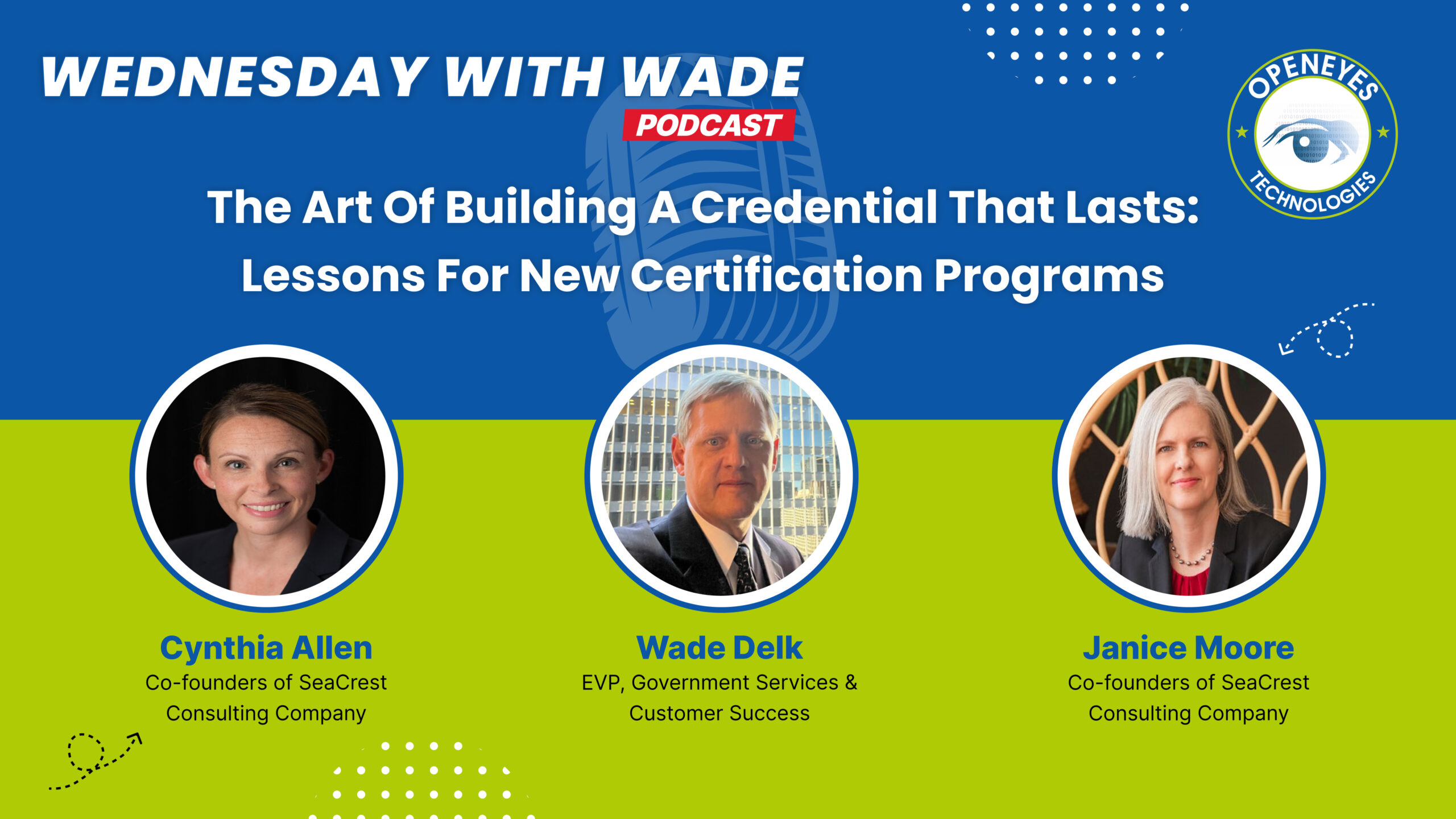
In this episode of Wednesdays with Wade, Wade Delk, Executive Vice President of Government Services and Customer Success at OpenEyes Technologies, welcomes longtime friends and industry experts Janice Moore and Cynthia Allen, co-founders of SeaCrest Consulting Company, one of the most respected names in credentialing strategy, accreditation, and certification program design.
Together, they dive deep into what it really takes to launch a credentialing program that stands the test of time, from knowing why you are creating it, to ensuring it remains credible, scalable, and defensible.
- The Art of Building a Credential That Lasts: Lessons for New Certification Programs 21:48
Key Takeaways
1. Don’t Start with Passion Start with Proof
Every great credential begins with a mission, but passion isn’t a substitute for market research.
Janice Moore explains:
“Boards are often filled with passionate leaders who believe a certification should exist but without understanding the actual market or audience needs, the program can easily miss the mark.”
Organizations should begin with data surveys, interviews, or competitive analysis to answer three critical questions:
- Why are we building this?
- Who is it really for?
- What problem are we solving?
Without clear answers, even the most well-intentioned credential can lose direction.
2. Understand What Your Audience Values
As Cynthia Allen emphasizes, validation is key:
“You have to talk to the people you are targeting not just assume what they need. Validate your assumptions through research, focus groups, or one-on-one discussions.”
Sometimes the solution isn’t a full certification at all, it might be a training program, competency assessment, or a microcredential. Understanding what learners and employers value ensures programs deliver relevance, not redundancy.
3. Doing It Right Costs Money, Doing It Wrong Costs More
Many organizations underestimate what it takes to build a defensible, high-quality credential.
Janice shares:
“You don’t have to reinvent the wheel. There are proven standards and models out there, use them. Trying to build everything from scratch can waste time and money.”
Best practices from accrediting bodies like the NCCA can save organizations from common missteps, even if formal accreditation isn’t the goal.
4. Think Long-Term: Build for Scalability, Not Just Launch
Early-stage enthusiasm often leads to overbuilding or under planning.
As Wade puts it:
“If you are opening a restaurant with ten tables, you don’t start building a hundred more. Grow when the demand does.”
Programs should be scalable, sustainable, and adaptable, evolving as the market and audience mature, from entry-level offerings to more advanced credentials.
5. Define What Success Looks Like, Before You Begin
SeaCrest encourages organizations to ask themselves:
- Should the program break even, generate profit, or operate at a mission-driven loss?
- How will we measure success: by revenue, reach, or impact?
- What story will we tell our stakeholders?
Janice notes:
“If you don’t define success upfront, you can’t manage expectations internally or externally.”
Aligning leadership around clear goals prevents conflict later and supports consistent messaging across all stages of the program.
6. Ending a Certification Is Harder Than Starting One
Cynthia highlights a point few leaders consider: once a certification is launched, it’s extremely difficult to discontinue.
“You have told people this credential matters. You have convinced them of its value. Ending it sends the message that maybe it wasn’t as valuable as you claimed.”
Ending a program can create perception issues, alienate certified professionals, and even introduce legal or reputational risk. It’s another reason due diligence upfront is non-negotiable.
7. Know the Difference: Certification vs. Certificate
A recurring challenge SeaCrest sees? Organizations thinking they have a “certification” when, in fact, they’ve built a training or certificate program.
Janice explains:
“There are clear definitions and standards for these products. It’s okay to have a hybrid but make that decision intentionally, not accidentally.”
Cynthia adds:
“If you are certifying someone as competent, you are making a legal and reputational claim. You need the evidence, standards, and structure to back that up.”
Understanding these distinctions helps protect both organizations and the professionals they serve.
Final Thought
A successful certification program isn’t built on good intentions alone, it’s built on clarity, research, and responsible design.
As Cynthia and Janice remind us, the most sustainable programs:
- Start with need, not assumption
- Validate with evidence
- Plan for growth and longevity
- Rely on standards and expert guidance
Listen to the Full Episode
Tune in to this week’s Wednesdays with Wade to hear Wade Delk’s full conversation with Janice Moore and Cynthia Allen and discover how to create a credentialing strategy that’s ethical, effective, and built to last.