


The Future of Credentialing: How Foresight Is Redefining Trust and Technology
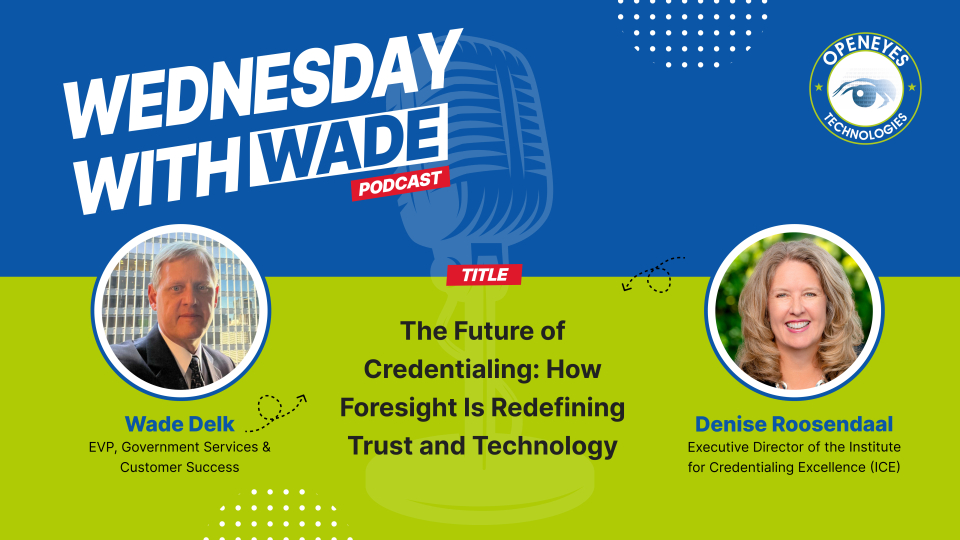
In this insightful episode of Wednesdays with Wade, Wade Delk, Executive Vice President of Government Services and Customer Success at OpenEyes Technologies, sits down with Denise Roosendaal, Executive Director of the Institute for Credentialing Excellence (.IC.E.).
Together, they explore a defining question for every certification leader today:
How do we prepare credentials and the systems behind them for a future that’s already here?
From AI-driven disruption and government influence to the shifting expectations of employers, Wade and Denise uncover how foresight thinking is helping credentialing organizations move from reactive to ready.
- The Future of Credentialing: How Foresight Is Redefining Trust and Technology 19:21
Key Takeaways
1. Foresight, Not Forecasting
The Future of Credentialing initiative wasn’t designed to predict trends; it was designed to build preparedness.
“Foresight isn’t a crystal ball,” says Roosendaal. “It’s about imagining a range of possible futures and taking action today to create the one we want.”
I.C.E.’s approach helps certification leaders identify external forces, technological, political, and social, that could reshape their work over the next decade.
2. Three Forces Driving Change
I.C.E.’s foresight paper highlights three forces that will define the next era of credentialing:
- Credentialing Under Pressure: The explosion of micro-credentials and nontraditional pathways challenges long-standing ideas of rigor and value.
- Government and Credentialing: As political polarization grows, credentials risk becoming ideological tools, making neutrality and transparency critical.
- Technology and Innovation: AI, VR, and automation are reshaping assessments. The challenge is ensuring these technologies are ethical, inclusive, and human-centered.
“AI was supposed to be a five-year trend,” Roosendaal notes. “Instead, it arrived in five months.”
3. From Insight to Implementation
ICE’s foresight work didn’t end with a report; it sparked a movement.
To ensure the findings drove real change, I.C.E. released practical tools, including:
- A Board-Focused PowerPoint Toolkit with key drivers and discussion prompts
- A Facilitator’s Guide for Strategic Workshops
- A Prioritization Survey to help organizations identify which risks and opportunities matter most
“The future can be intimidating,” Delk adds. “But the more you understand it, the less scary it becomes.”
4. The Value of Uncomfortable Conversations
Roosendaal emphasizes that progress often begins with discomfort. At I.C.E.’s Future of Credentialing Summit, experts from higher education, technology, and workforce sectors will openly question credentialing’s current value.
“We are inviting critics as well as champions,” Roosendaal says. “It’s uncomfortable, but that’s where growth happens.”
By exploring how outsiders view the credentialing world, I.C.E. hopes to strengthen trust and relevance from the ground up.
5. Aligning with Employers
The next evolution in credentialing isn’t more exams; it’s about deeper alignment with workforce realities.
“Employers are often the ones funding certifications,” says Roosendaal. “We need to understand their expectations and demonstrate why credentials matter.”
By focusing on employer validation and competency outcomes, credentialing bodies can reinforce both credibility and career value.
6. Balancing Optimism with Realism
Roosendaal admits the foresight process changed her own outlook.
“I am an optimist, but this work reminded me that the future won’t automatically be better. We have to shape it.”
Foresight, she explains, is about balancing optimism and pragmatism, seeing risks and opportunities side by side, and preparing leadership, finances, and culture for both.
7. Preparing Today for Tomorrow’s Pressure
With rapid advances in AI, automation, and global competition, credentialing bodies can no longer rely on incremental updates. They need to embed future-readiness into their DNA.
I.C.E.’s foresight framework gives leaders a structured way to look beyond the day-to-day and make intentional, long-term decisions that keep credentials relevant in a fast-changing world.
Final Thought
The credentialing world is standing at a crossroads, caught between tradition and transformation.
Foresight offers a path forward: one grounded in preparation, not prediction.
“If we want a preferred future,” Roosendaal concludes, “we have to start building it now.”
Listen to the full episode of Wednesdays with Wade to hear Wade Delk’s complete conversation with Denise Roosendaal and discover how foresight can future-proof your organization’s mission.