


Beyond the Exam: Why Recertification Defines the Future of Credentialing
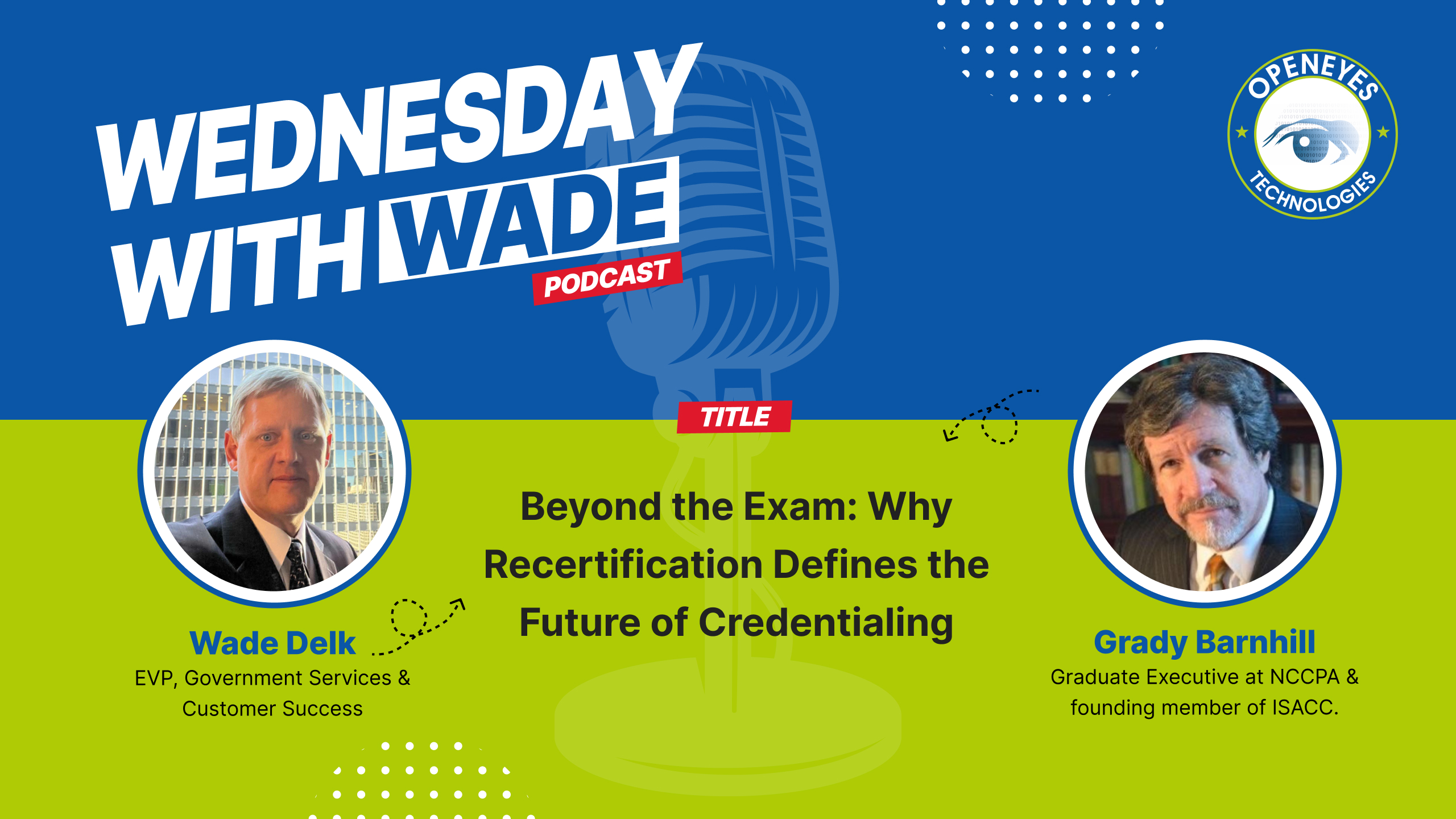
In this insightful episode of Wednesdays with Wade, Wade Delk, Executive Vice President of Government Services and Customer Success at OpenEyes Technologies, sits down with Grady Barnhill, retired Executive from the National Commission on Certification of Physician Assistants (NCCPA) and founding member of the International Society for the Advancement of Continuing Competence (ISACC).
Together, they explore one critical question shaping professional standards today:
What does a credential truly mean, and how do we ensure it continues to matter throughout a professional’s career?
From knowledge decay and recertification reform to data-driven CE and third-party validation, Wade and Grady discuss how continuing competence is becoming the cornerstone of trust, safety, and professional excellence across industries.
- Beyond the Exam Why Recertification Defines the Future of Credentialing 21:04
Key Takeaways
1. The $117 Billion Price of Inactivity
Most organizations excel at onboarding and initial certification, but what happens after that?
“We do a great job at the front end,” says Barnhill. “But too often, maintaining that competence becomes a checkbox.”
ISACC’s mission is to make credentials signify ongoing competence, rather than simple completion.
2. Recertification May Matter More Than Certification
A study found that professional performance declines with time in practice, a phenomenon known as knowledge decay.
“The idea that we get better with age doesn’t always hold up,” Barnhill notes.
Recertification isn’t bureaucracy; it’s how professions protect the public and maintain trust.
3. Smarter CE, Stronger Learning
Not all continuing education (CE) is created equal. Research shows better outcomes when CE:
- Includes test-enhanced learning
- It is spread across sessions.
- Reinforces learning through reminders and follow-ups
“If a CE course uses evidence-based methods, why not reward it?” Barnhill suggests.
4. Data and Technology Are Raising the Bar
With tools like CROWN, a powerful Credential Management System by OpenEyes, organizations can now identify which CE programs are most effective.
“That kind of insight helps steer learning where it has real impact,” says Delk.
5. Validation and Shorter Cycles Build Trust
Barnhill supports third-party accreditation and shorter recertification cycles with continuous, “micro” learning touchpoints.
“Each assessment should be a learning experience, not just a test,” he emphasizes.
6. ISACC’s Vision
Since 2023, ISACC has been driving research, recognition, and reform in continuing competence.
Its first award honored the College of Physicians and Surgeons of Alberta for its risk-based regulation model, a smarter approach to protecting the public.
7. Lifelong Learning in Action
Even in retirement, Barnhill embodies his message, pursuing photography, music, and motorcycling with the same curiosity he brings credentialing.
Final Thought
Certification is no longer a one-time milestone; it’s a living commitment to excellence.
Organizations like ISACC and tools like CROWN shift credentialing from static checks to ongoing validation of competence and trust.
“What we do matters,” Barnhill concludes. “Staying current is the ultimate form of public protection.”
Listen to the full episode of Wednesday with Wade to hear the complete conversation with Grady Barnhill and discover how you can champion ongoing competence in your own organization.